Blog
Get Pay Right on ADP Workforce Now® Next Gen™
Bringing trusted compensation intelligence and seamless planning to even more ADP users.
Written by Salary.com Staff
April 30, 2026

A sales compensation plan is a structured system that provides an explanation of how employees receive their salaries. Many organizations use this strategy to increase the motivation of the sales teams to meet specific sales targets. If you are building a compensation plan or want to improve your existing plan, this article is for you.
Here you will find a comprehensive guide to building a sales compensation plan from the basics and components to the steps you can take to build one and improve its structure.
A sales compensation plan defines how employees earn and what they must do to collect it. It ties pay to performance and includes base pay, commissions, bonuses, and quota requirements. Without it, team members may lose focus or be unmotivated.
These can be customized to suit the company’s goals, such as incentivizing new customer acquisition. The plan must be simple and equitable for the reps to trust it. When the plan is executed well, they see higher performance and dependable growth.
Sales compensation must also align with company-wide reward principles. The Total Rewards Strategy supports integrating sales incentives into the broader compensation and benefits strategy. I included this to ensure sales pay aligns with long-term talent objectives.
There are six essential components that make up a compensation plan. The first component is a base salary, which is the financial stability provided to the employee.
In addition to the base salary, there is variable pay, which includes commission and bonuses. These three components make up the On-Target Earnings (OTE), which is the total amount of pay an employee should expect if they reach 100% of their quota.
The other components include the commission structure, quota setting, and performance metrics. These components make up the core elements of a compensation plan.
Base salary
Variable pay
On-targer earning
Commission structure
Quota setting
Performance metric
The fixed amount of money that is paid to the employee. This offers the advantage of security and can be an attractive incentive to talent. Typically, base salary accounts for 50 percent of the OTE. Thus, a $120,000 OTE represents a $60,000 base salary. Salary Structure Building supports the creation of formal pay grades and salary ranges to maintain internal equity.
This is an additional amount of money that is given to the sales representative if they achieve results beyond the expected level. This can either be in the form of commissions, bonuses, or both. It could be 3 to 10 percent of the revenue they bring into the company. For instance, if a sales rep generates $1 million in sales, the variable part of their pay could be $50,000.
The OTE component sets clear expectations on how much reps can earn. Reps get a specified guaranteed amount. Then there is a portion left to quotas and commissions. A popular split is 50/50. So, a salesperson with $150,000 OTE understands they will earn $75,000 base and up to $75,000 in incentives.
The commission structure sets out how much additional income will be gained from sales. Reps could earn a flat rate or even an escalating structure that rewards higher performance. For example, reps can earn 6 percent on all sales up to their quota and 9 percent above the quota sales.
Quota setting aims to present sales targets based on market realities. The sales management team looks at historical data, territory potential, and market economic forecasts. Sales quotas could be $600,000 for one region and $900,000 for another. The sales rep must be able to meet the quota if they put in the effort.
Performance metric components also measure other important sales activities besides revenue. This includes the number of new logos, average deal size, and renewal rates. A sales plan could include a 10 percent bonus for sales reps that hit 120 percent of their quota and strong customer satisfaction scores. This ensures that the sales team is committed to quality sales too.
A compensation plan is built from first principles with clear business objectives, and it results in a fair and motivating program that people understand.
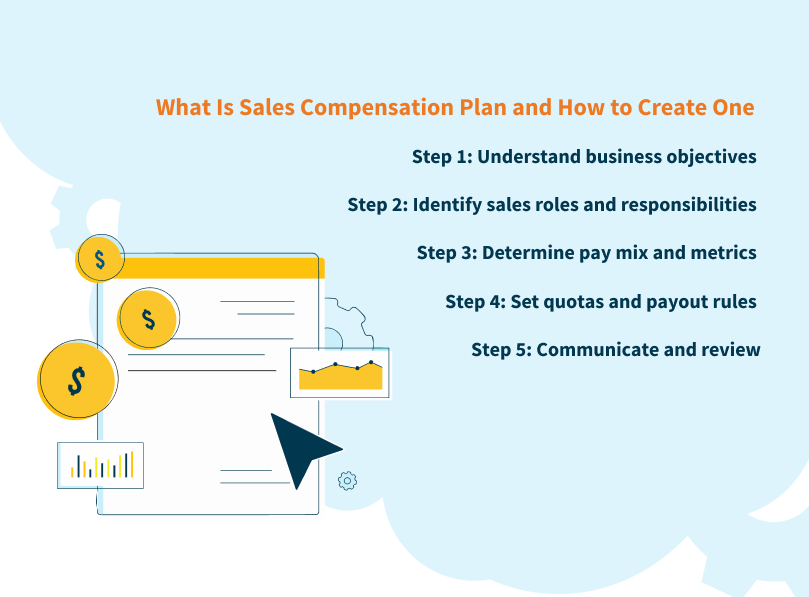
Begin by defining the goals your company wants the sales team to support, such as growth targets, market expansion, or customer retention.
Different roles (e.g., new business hunter, account manager, technical seller) may require different pay mixes to reflect their influence on results.
Decide how much pay is fixed (base) versus variable and select metrics like revenue, margin, retention, or product mix to incentivize.
Assign realistic quotas based on historical data and market potential and define how and when payouts occur.
Launch the plan with clear documentation so reps understand how earnings work. Regularly review performance and market data to update the plan as needed.
Different companies structure their compensation plans differently, depending on their sales cycle, goals, and other factors. An organization’s sales compensation structure determines how employees are paid and how much earning potential or income stability they offer.
Many companies have adopted strategies that increase payouts under certain circumstances or provide advances on earnings, which are deducted from future earnings. These measures serve various purposes, but they ultimately motivate strong performance from salespersons and maintain momentum throughout the year.
Straight commission
Base Plus commission
Tiered commission
Draw against commission
Reps earn only commissions with no base salary. This works well in industries like real estate where deals are large. Example: A rep earns 10% of every closed sale. It offers unlimited upside but can feel risky for new hires.
This popular mix gives a steady base salary plus commission on sales. Many tech companies use a 60/40 split. Example: $80,000 base plus 6% commission. It balances security with strong performance drive.
Commission rates increase as reps hit higher sales levels. It rewards top performers extra. Example: 5% up to quota, then 8% above quota. Teams love the extra motivation to keep selling.
The company gives an advance (draw) that reps pay back from future commissions. It helps during slow months. Example: A $4,000 monthly draw against 7% commissions. Reps must track their balance carefully.
Good governance keeps a compensation plan fair, legal, and trustworthy for years. It protects the company and builds confidence in the sales team.
Good governance ensures that the compensation plan remains fair, legal, and effective.
Creating a cross-functional governance committee, including members from sales, finance, HR, and legal.
Documenting every rule clearly and training all managers to apply them correctly.
Staying current on relevant laws and regulations and updating the compensation plan when they change.
Using sales compensation data to audit the plan regularly. Using these audits to identify and correct errors.
Regularly monitoring and reporting plan payouts against forecasts to maintain transparency.
Strong governance ensures compensation plans remain fair, compliant, and transparent. Pay Equity & Transparency supports equitable compensation practices across the workforce.
Here are some FAQs for better understanding:
Most experts recommend reviewing the plan at least once a year. This keeps it current with market changes and business needs. In fast-moving industries, a quick check every six months can help catch problems early. According to Salary.com suggests annual reviews of incentive plans, with some companies choosing semiannual checks for faster response.
Common pitfalls include:
Setting quotas that are impossible to achieve, leading to frustration
Making the plan too complicated so sales reps can’t easily figure out their pay
Changing the plan too often, which erodes trust
Not aligning pay with market rates, risking talent loss
Failing to align incentives with the company’s real priorities (e.g., profit, customer retention)
Yes, team-based incentives can work very well when sales roles require close collaboration. They encourage sharing leads and helping each other close to bigger deals. However, they may not suit every situation. WorldatWork notes that team measures strengthen a “win-together” culture in collaborative settings, while individual measures fit independent roles better.

The latest research, expert advice, and compensation best practices all in one place.
Blog
Bringing trusted compensation intelligence and seamless planning to even more ADP users.

Blog
Learn how to train managers for effective pay conversations and build trust.

Blog
Total rewards package flexibility lets employees choose what matters - pay, perks, and benefits tailored to their needs.