Blog
Get Pay Right on ADP Workforce Now® Next Gen™
Bringing trusted compensation intelligence and seamless planning to even more ADP users.
Written by Salary.com Staff
April 30, 2026

Human capital ROI shows the real financial return your company gets from every dollar spent on employee compensation. Compensation professionals track it to prove that pay programs create value instead of just adding cost. It helps you decide where to invest in salaries, bonuses, or incentives so the business grows stronger.
This guide is your clear, step-by-step resource for understanding and using human capital ROI in daily HR and compensation work. It covers the basics, simple calculations, and practical ways to improve results with incentives.
Human capital ROI measures the profit your workforce creates compared to what you spend on pay and benefits. You take revenue, subtract all operating costs except compensation, and then divide by total compensation costs.
The result tells you how many dollars come back for each dollar invested in people. Compensation teams love this metric because it speaks the same language as finance leaders.
This number focuses only on the value people add after other expenses. It includes base pay, bonuses, benefits, and training costs. A score above 2.0 usually means strong returns. You can track it over time to see if your compensation strategy works.
HCROI includes all compensation elements--base pay, bonuses, benefits, payroll taxes, equity, and training expenses. Compliance accuracy is equally important, which is why many teams reference Minimum Wage Data to ensure statutory pay obligations are reflected in total cost calculations.
HCROI and revenue per employee both look at workforce value but measure it in very different ways.
| Aspect | HCROI | Revenue per employee |
|---|---|---|
| What it measures | It shows profit returned after all costs except compensation, divided by compensation spending. | It simply divides total revenue by the number of employees. |
| Focus area | It connects directly to compensation costs and shows if pay investments pay off. | It ignores all costs and only counts revenue share per person. |
| Use in compensation | Compensation teams use it to justify incentive plans and total rewards budgets. | Leaders use it for quick headcount productivity checks but not for pay decisions. |
| Strength for HR | It proves the financial impact of your programs in clear dollar terms. | It gives a fast snapshot but misses the true cost of human capital. |
Individual incentive plans raise HCROI by tying extra pay directly to results that grow revenue or cut costs.
They keep base pay steady while adding variable costs only when employees hit targets, so compensation spending stays efficient.
Top performers earn more and deliver higher output, which lifts the value-added number in the formula without raising fixed costs.
Clear targets make employees focus on business goals, which improves overall profit per compensation dollar.
When incentives work well, companies see fewer low performers dragging down the average return.
Companies designing structured pay-for-performance programs often use Compensation Planning Software to align merit increases, bonuses, and incentives with business targets.
Variable pay improves contribution margin by making part of compensation rise and fall with actual performance instead of staying fixed.
It turns some labor costs into true variable costs that only increase when sales or profits grow.
Managers can reward strong results without locking in higher base salaries that hurt margins in slow periods.
Employees stay motivated to control costs and boost output because their pay depends on it.
Over time, this creates a healthier gap between revenue and variable costs, which lifts overall profitability.
Performance metrics (KPIs) drive HCROI outcomes by giving clear targets that link daily work to financial results.
KPIs like sales per employee or project completion rate show exactly where value comes from.
When you tie pay to these measures, compensation dollars flow to the actions that increase revenue or lower costs.
Regular KPI reviews let you adjust incentives, so returns stay high.
Teams with strong KPI alignment usually report higher HCROI because every dollar spent creates measurable value.
Performance differentiation is critical to HCROI because it directs bigger rewards to people who create the most value.
Top performers receive higher incentives, which raises average output without raising costs for everyone.
Clear pay gaps between levels motivate everyone to improve and protect the overall return.
Without differentiation, average and low performers dilute the ROI because compensation dollars go to lower results.
Companies that differentiate well see stronger talent retention and better financial returns from their pay programs.
The right way to calculate HCROI follows four clear steps that use real company numbers and stay simple to repeat each quarter.
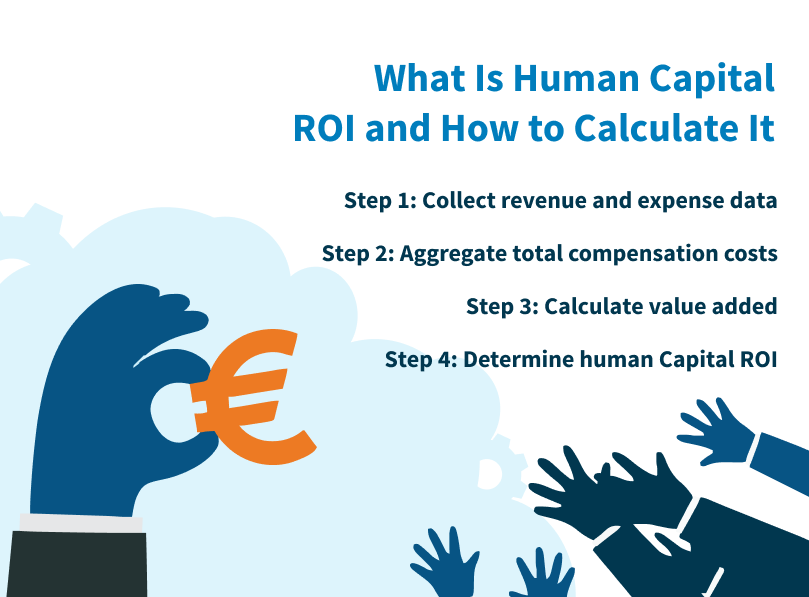
Begin with total revenue for the measurement period and subtract all operating expenses except for compensation-related costs to determine the value generated by your workforce.
Include all employee-related expenses such as base salaries, bonuses, benefits, payroll taxes, and training for both full-time and variable staff.
Deduct non-compensation expenses from revenue to quantify the profit attributable to employee contributions.
Divide the value added by total compensation costs and express as a percentage. For example, a result of 2.0 indicates $2 returned for every $1 invested in people. Monitor trends over time to inform compensation strategy.
Strategic guidance for structuring compensation budgets can be found in Salary Planning Strategies, which aligns pay design with financial goals.
Here are some examples calculations for HCROI:
Scenario 1 – Sales team bonus plan
A mid-size company has $10 million in revenue and $6 million in non-compensation operating expenses. Total compensation costs are $2.5 million, which includes $400,000 in individual sales bonuses paid only when targets are met. Value added equals $4 million. HCROI is $4M / $2.5M = 1.6. The bonuses helped hit higher revenue without raising fixed pay.
Scenario 2 – Production incentive program
Another firm reports $8 million revenue, $5 million non-compensation costs, and $2 million total compensation that includes $300,000 in performance incentives for meeting quality and output goals. Value added is $3 million. HCROI reaches $3M / $2M = 1.5. When incentives drove better output, the company kept costs low and improved the return.
In managing individual incentives, certain best practices can help the company sustain and even improve ROI from its human capital investments. These best practices include the following:
Setting clear, measurable targets that impact the company’s revenue or cost savings
Reviewing the data from incentive program payouts regularly and adjusting targets to mitigate any risks to the ROI
Clearly communicating the plan to employees
Combining the incentives program with regular performance discussion
Tracking the actual ROI impact of the incentives program and communicating the results to leadership to secure further funding
Here are some FAQs for better understanding:
Yes, HCROI does account for long-term incentives like equity grants. All compensation costs (including equity grants) are factored into HCOI calculations. Most experts agree that equity grants should be included in HCROI calculations in their accounting expense value (for accuracy).
Yes, HCROI can be calculated separately for different segments of employees that have different long-term incentive plans. Calculating HCROI for different segments can give an organization insight into the effectiveness of different long-term incentive plans. This insight can be helpful in fine-tuning compensation strategies.
Compensation teams should calculate HCROI at least once per quarter to catch any issues early. HROI calculations performed at year-end will be accurate because all factors can be accounted for. However, annual calculations can be helpful for long-term trend analysis.

The latest research, expert advice, and compensation best practices all in one place.
Blog
Bringing trusted compensation intelligence and seamless planning to even more ADP users.

Blog
Learn how to train managers for effective pay conversations and build trust.

Blog
Total rewards package flexibility lets employees choose what matters - pay, perks, and benefits tailored to their needs.